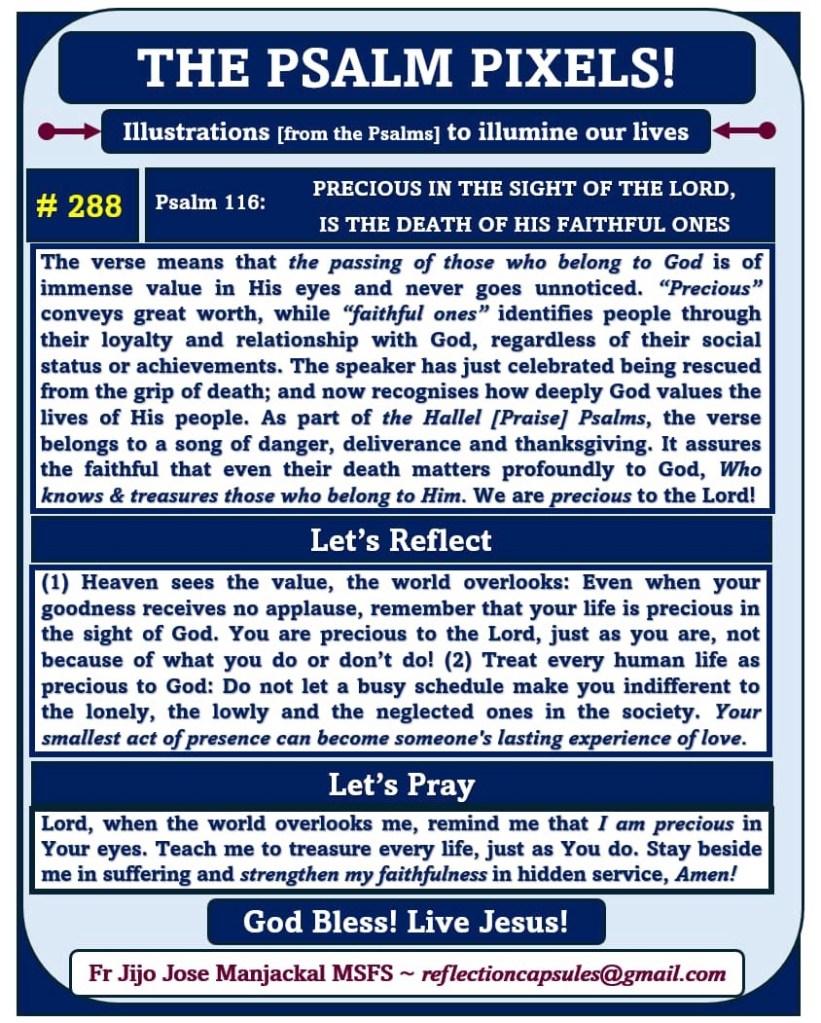
The Psalm Pixels #288
“Allowing God to take charge of our lives and offering all to His Hand, so that small things grow large and small gifts expand!”
(Based on Eph 5:21-33 and Lk 13:18-21 – Tuesday of the 30th Week in Ordinary Time, Year 2)
A young Christian businessman who had established himself well in his area of work, was once interviewed by a journalist…
… and asked for the secret of his quick success.
“Well”, said the young businessman, “I attribute all my success to my Lord!
From my college days, I have sought to give God the first place in my life.
And He has always led me!
There is a simple formula that I always hold on to…
The formula goes thus:
‘Where God’s in charge,
Little things grow large!
And in God’s Hand,
Small gifts expand!”
So true, isn’t it?
If we allow the Hand of God to work even in the small things that we do…
… we will surely experience the bountifulness of His Grace working miraculously!
The Gospel of the Day is a recounting of this Great Truth of our life, when Jesus expounds the “Miracle of God’s Hand in the littleness of our life” with the help of two examples:
1) The Mustard Seed
“… a grain of mustard seed which a man took and sowed in his garden…
… and it grew and became a tree, and the birds of the air made nests in its branches!” (Lk 13: 19)
2) Leaven
“… like leaven which a woman took and hid in three measures of flour, till it was all leavened!” (Lk 13:21)
One of the beautiful lessons that the Lord teaches from these two metaphors of daily life is that: Our little works done for God, should never cause us to feel discouraged in life!
The little mustard seed and the little leaven…
… were not really expected to do great things
… were not quite symbols of greatness or majesty
Yet, the Lord – in His Divine Wisdom – uses these “little aspects of life” to project His Mighty Story of the Kingdom!
St Paul says: “God chose the foolish of the world, to shame the wise…
… and God chose the weak of the world to shame the strong..” (1 Cor 1: 27)
This is the truth we come across in the Mighty Story of the Kingdom, as we scan through the pages of the Bible…
… even in the Life of Jesus!
Jesus was born into a small Family from Nazareth in the smallest of villages (Bethlehem).
His Ministry started in one of the smallest places – Galilee.
Galilee was an insignificant portion of an obscure part of the Roman world.
He went no further than Jerusalem with His message
In the time of the Roman Empire, Jerusalem was not considered a cultural centre.
… Rome, Athens and Alexandria featured more prominently on the political and cultural radar.
In fact, for the Romans, Jerusalem was a city of fanatic Jews – to be best controlled by an army of troops and easily-swaying kings like Herod and his family!
Yet, Jesus has become the greatest influencer in Human History!
“Where God’s in charge,
Little things grow large!
And in God’s Hand,
Small gifts expand!”
Life doesn’t always give us great opportunities to perform big acts of charity and kindness.
But our life is filled with immense chances…
… to “sow tiny mustard seeds”
… and to “mix little leaven”…
Do we make the best use of such chances:
To sow the “tiny mustard seeds”…
Of Gentleness… in the rough terrains of pride and haughty lives
Of Love… in the field of broken relationships and strained associations
Of Mercy… in the territories of hateful feelings and unforgiving hearts
To “mix the little leaven”…
Of undiluted Christian convictions… in the dough of easy-going-life and relativistic mentality
Of contagious passion… with the flour of lethargic and lazy attitudes to life
Of credible life witness… in the mixture of scandalous trends and discouraging religiosity
Servant of God, Fr Peter Mermier (the Founder of the MSFS – Missionaries of St Francis de Sales) says:
“We do a lot in doing a little, if we do it for God, when and as He wishes!”
God doesn’t mind much the size of our works…
… but at the amount of love we add to it!
God doesn’t look at the fanfare in our acts of service…
… but at the volume of selflessness we add to it!
St Paul tells us: “… Christ is the Head of the Church, His Body, and is Himself its Saviour…” (Eph 5:23)
Of course, the world may not appreciate such “simple and little works!”
But let the “tiny mustard seed” and the “little leaven” remind us: Our little works done for God, should never cause us to feel discouraged in life!
Yes…
“Where God’s in charge,
Little things grow large!
And in God’s Hand,
Small gifts expand!”
(P.S: Psst… Did you add an “extra bit of God’s Love” while reading this reflection…?)
God Bless! Live Jesus!
“Experiencing the Healing Touch from the Lord of all Liberation and Wholeness!”
(Based on Eph 4:32–5:8 and Lk 13:10-17 – Monday of the 30th Week in Ordinary Time, Year 2)
There is a simple little poem, which goes thus:
“A horse can’t pull, while kicking,
This fact we merely mention.
And he can’t kick, while pulling,
Which is our chief contention!
Let’s therefore, imitate the good horse
And lead a life that’s fitting;
Just pull an honest load, and then
There’ll be no time for kicking!”
These few lines of the poem explain in interesting terms…
… on how the aspect of criticism and bad-mouthing is a result of a lack of focus and proper attitude!
Are we sometimes people who fail to have such “horse-sense?”
This lack of a “horse-sense” can lead to the…
… habit of spitting out unpleasant words at others, without the least concern.
… practise of spitting out harsh and judgmental words, with minimal mercy.
… tendency to spitting out critical words to put down people in humiliation.
The Gospel of the Day brings a classical example of a person who failed to have this “horse-sense”.
The context of the Gospel passage is that of Jesus healing a woman who had been crippled for eighteen on a Sabbath Day.
However, after the healing, the leader of the synagogue was indignant that Jesus had cured on a Sabbath.
He told, “There are six days when work should be done.
Come on those days to be cured, not on the Sabbath day” (Lk 13:14)
This leader of the synagogue, was displaying the lack of a “horse-sense”.
Here was something noble and good being done…
But he fails to see the goodness and instead shouts at the people for not keeping the laws.
Here was something miraculous and godly being performed…
But he closes himself to the Kingdom of God and focuses on the need to obey human rules.
His lack of “horse-sense” seemed badly exposed!
Jesus, the Lord of healing and restoration, encountered the woman who had been crippled for many years…
She was bent.
She was in pain probably.
She was also very much dispirited too.
Jesus saw her need…
… but the leader of the synagogue saw her as a nuisance.
Jesus understood her pain…
… but the leader of the synagogue chose to inflict shame on the people.
This is the trouble very often: One concentrates only on the negative aspects of persons and situations!
Jesus lashes out at such an attitude!
He calls the leader of the synagogue a hypocrite, and draws his attention to the greater and important dimensions of life!
“This daughter of Abraham, whom Satan has bound for eighteen years, ought she not have been set free on this Sabbath day from this bondage?” (Lk 13:16)
The man focused on the rule of Sabbath…
… Jesus focused on the Law of Love and Liberation.
The man saw the commandment violated…
… Jesus saw a life that had been violated and was in need of renewal.
The man burst out in anger and pride…
… Jesus blossomed out in Compassion and Humanness.
Do I display any such characteristics?
Failing to see the goodness in people…
… and instead speak only of their faults and mistakes?
Failing to trust in God in hard situations…
… and instead only criticize and blame God?
Getting wild with people for tiny faults…
… without considering their context and circumstances?
Spreading calumny and rumours…
…. about the unpleasant aspects of others?
The Lord of all Liberation and Wholeness today invites us to experience His Healing Touch.
Many of us are crippled and infirmed…
We need a healing.
We need a touch of the Lord.
A negative attitude in life can cause much damage to the people around us.
It can make our life unclean and miserable and cause people to avoid us.
It can make our families, our communities and our societies to be unlivable and unpleasant.
A strong decision needs to be made: to stop the usage of…
… bad words
… defamatory news
… harmful statements
… uncharitable remarks
… and to stop spitting cruel and heartless comments!
Let us be aware:
“A horse can’t pull, while kicking,
And he can’t kick, while pulling,
Let’s therefore, imitate the good horse
And lead a life that’s fitting;
Just pull an honest load, and then
There’ll be no time for kicking!”
God Bless! Live Jesus!
“Becoming an Apostle and Agent and Ambassador of Love!”
(Based on Exod 22:20-26, 1 Thess 5c-10 and Mt 22:34-40 – Sunday of the 30th Week in Ordinary Time, Cycle A)
There once was a farmer who grew award-winning ‘corn’ (maize).
Each year he entered his corn in the fair-competition conducted at the state-level, where it won a prize.
One year a newspaper reporter interviewed him.
Among the many great practices that this farmer had adopted, the reporter also learned something highly interesting about how this farmer grew corn…
…and which made him to win a prize every year.
The reporter discovered that the farmer shared his seed corn… his best variety seed…
… with his neighbouring farmers!
“How can you afford to share your best seed corn with your neighbours…
… when they are also entering into competition with you?” enquired the bewildered reporter.
“Why sir,” replied back the farmer, “didn’t you know one of the important realities of life?
The wind picks up pollen from the ripening corn and swirls it from field to field.
If my neighbours grow inferior variety of corn, the cross-pollination will steadily degrade the quality of my corn as well.
If I am to grow good corn, I must help my neighbors grow good corn.
This is the reality of life that I have realized: In order to get the best out of life, I need to give my best to the other!”
Yes, the farmer was very much aware of the relatedness of life.
His corn could not improve unless his neighbor’s corn also improved.
Have we realized this reality of our lives?
In order to get the best out of life, I need to give my best to the other!”
Those who choose to live well, must help others to live well too.
The value of a life is measured by the lives it touches and the love we display
And those who choose to be happy must help others to find happiness…
… for the welfare of each is bound up with the welfare of all!
Yes, Love is the starting point, the end and the essence of a Christian Life.
The Gospel of the Day emphasizes and affirms this aspect of Love: Love of God and Love of neighbour.
The Pharisees come together to trap Jesus with a question from the Law: “Teacher, which is the most important commandment of the Law?” (Mt 22:36).
The Lord of Love is sought to be trapped in a web of malice!
This was a complicated question that was put forward to Jesus.
The Jewish Law of the Torah comprised 613 precepts.
It was certainly a challenge to condense these codes into a single commandment.
Probably Jesus would’ve looked into the eyes of the one who asked this question and thought, “Why do you seek to put me to the test?”
There was malice and a corrupt intention in the one who questioned.
But the greatness of the Lord overwhelms the evil designs of humans.
Jesus answers the question which had an evil bent, with an answer filled with goodness…
… “Love the Lord your God with all your heart, with all your soul and with all your mind….
Love your neighbour as yourself”! (Mt 22: 37)
Bingo..!
Two birds with one shot!
He not just answered His interrogators but He also proclaimed the summary of the Gospel.
The Pharisee came asking which is “the” greatest commandment (Mt 22: 36)
He expected just one commandment.
But Jesus answers with two…
… and showed that those two commandments are nothing but one!
The Love of God and the Love of neighbour…
They were two dimensions of the same Love.
And this One Love, with two facets, formed the basis of all the other commandments of the Law!
The tragedy of our world and our spirituality very often, is the separation of these two dimensions…
One loves God…
… but fails to love one’s neighbour!
Another loves the neighbour…
… but fails to love God!
One loves to read and hear and understand God’s Word…
… but fails to apply it in real life.
Another loves to have a lot of social relations…
… but fails to build a strong spiritual basis.
One loves to preach deeply over virtues of the Gospel…
… but fails to live them in actuality.
Another loves to be in friendship with all…
… but fails in closeness with God, the source of Love.
One loves the Church and her teachings…
… but falls short to serve the society and its peoples.
Another serves people…
… but vehemently hates the Church, the ark of the Sacraments of Love!
Christian love is not just about emotions.
Christian love is not just about feelings.
Christian love, is…
… making a decision to serve, even if one does not feel so.
… being faithful, even if one is rejected or even shown indifference.
… being committed, even if one feels an aversion towards the other.
Easier said, than done… right?
This is where, we need to…
… depend on God, the Source of Love itself!
… draw strength from the Sacraments that the Church offers!
… display a Passionate love of God in order to share it with others!
Unless we are in Communion with the Lord, all this reflection remains merely a theory.
Unless we are joined to God, the Source of Love, all our meditations remain superficial.
We need to pray as the Psalmist says: “I love you, Lord, my strength” (Ps 18: 2).
He is the strength for us to love our neighbour.
The world is thirsting for Love…
Each one of us is called to radiate this Love: Love of God and Love of Neighbour.
Yes, let us deepen our realization: “In order to get the best out of life, I need to give my best to the other!”
Let us become an Apostle and Agent and Ambassador of Love!
God Bless! Live Jesus!

“Having the Wellspring of Hope, even when life traps us in ‘the dark mines of difficulties and despair!'”
(Based on Eph 4:7-16 and Lk 13:1-9 – Saturday of the 29th Week in Ordinary Time, Year 2)
August 5, 2010.
In the San José Mine of Chile, a sudden collapse trapped 33 miners under 2,300 feet of rock.
The world above had no way of knowing if they were alive.
Days passed.
No food. No water.
Just darkness, heat, and despair.
Seventeen days later, when all hope seemed lost, a drill finally broke through.
As it was pulled back up, a small note was attached: “Estamos bien en el refugio, los 33” – “We are well in the shelter, all 33 of us.”
The world erupted in joy!
The rescue mission intensified.
But there was one problem – getting them out would take time…
… the miners would have to survive 52 more days underground.
But down below, something remarkable was happening
Cut off from the world, these men turned to God.
Many of them had never thought about God before. But now?
Now they realized – no money, no success, no strength could save them.
Only God could.
Buried beneath the earth, they discovered that even in this “unfortunate situation,” God was very powerfully with them.
And later, when they were finally rescued—after 69 days in darkness, one of them testified: “We were 33… but God made us 34.
He was with us the whole time.”
Life often traps us in ‘the dark mines of difficulties and despair!”
But we are reminded that “Hope does not disappoint!” (Cf. Rom 5:5)
God is always with us!
The Gospel of the Day opens our eyes to consider the “Jesus” way of looking and understanding such “uneventful” mishaps and “tragic” calamities.
Humanity is a daily witness to calamities, catastrophes, adversities and disasters.
Tragedies occur in the life of every human being.
Every now and then, we hear of many reports of unpredictable or unimaginable misfortunes occurring in the lives of people – tsunamis, floods, earthquakes – or bomb blasts, mass killings, wars etc.
In our own personal lives too, we experience a lot of painful moments…
…. very often, unexpectedly.
In the face of all these horrors… we are faced with many doubts and questions:
Why do these things happen to the innocent?
Why doesn’t the Good and Loving God do anything about all this?
Sometimes, we even take on a critical and judgmental attitude and say, “Probably, God is punishing all these people for their sins or their misdeeds”
In today’s Gospel, Jesus is presented with a couple of human tragedies and made to react on them.
The first tragedy is about the Galileans who suffered at the hands of Pilate (Lk 13: 1-3)
The second is about the people who dies when the tower of Siloam fell on them (Lk 13: 4)
The first one is about a disaster brought about because of the cruel deeds of human beings
The second because of the misfortunes in nature.
In both these cases, however, the people who died, were mere subjects to death…
They had an unfortunate death, without perhaps really being guilty.
And so the natural reaction of the people of the times was that, the people who died would have been greater sins, and they are being punished by God.”
“These people deserved death because of their sins” was the popular slogan of those times.
Perhaps, when faced with calamities, we too often take upon this judgmental attitude,
But here Jesus points out the great reality…
These calamities and disasters are not to be another occasion for us to pass judgments
Rather, they become golden opportunities for us to make a self-reflection on our lives.
Like the tree which is given one more year – to be dug around, to be given manure and to produce…
… these tragedies and events in life, present us with more time to examine, how do we live our lives.
Do we take our lives for granted?
Perhaps, we have a tendency to often think there is plenty of time in life.
And complacency creeps into our life.
But these tragedies point to us the fact, that after all human life is very short.
And in this short-lived life, we need to make the best use of God’s graces to repent and to lead a Holy life.
In Rev 22.7, Jesus says “Behold, I am coming soon”
As Christians, we believe in the Coming of the Lord.
No one knows the hour
No one knows the day
But, being prepared, being vigilant always, is a must, is a necessity.
St Paul tells us: “we are to grow up in every way into him who is the head, into Christ…” (Eph 4:15)
Human tragedies and personal misfortunes are to be understood as God’s manifestations of Love for us, to have our lives set clearly on our priorities for God and His Kingdom
They are not to evoke fear or elements of judging
Rather, should prompt us to take life more seriously, and to make Real Repentance and live a Holier lives.
To grow in our love and trust in the Lord, one of the practical tip that we all need to practice is the Daily Examination of Conscience.
When we daily examine our conscience, and make efforts to amend our lives with true repentance…
… we are able to live the graces that are showered on us.
Also, a meaningful Regular Confession helps us not only to be forgiven of our sins…
… but also gives grace to lead a more holy and unblemished life.
Live will often trap us in “the dark mines of difficulties and despair!”
Yet, even in the deepest darkness, there is a wellspring of hope.
Let us be vigilant and keep guard over the sanctity of our lives…
… and Be His, forever!
Today we also seek the intercession of St Antony Mary Claret, the founder of the Congregation of the Missionary Sons of the Immaculate Heart of Mary (CMF – Claretians)…
…. and be inspired by his words:
“Love is the most necessary of all virtues.
Love in the person who preaches the word of God is like fire in a musket.
If it is spoken by someone who is filled with the fire of charity- the fire of love of God and neighbour…
… it will work wonders!”
Let us pray for all the Claretians, who are celebrating the Feast of the Patron Saint…
… and for all the Missionaries of St Francis de Sales (MSFS) on their Foundation Day!
God Bless! Live Jesus!
“Seeing the signs, recognizing God’s power and marching joyfully in Him!”
(Based on Eph 4:1-6 and Lk 12:54-59 – Friday of the 29th Week in Ordinary Time, Year 2)
One foggy night, a storm was brewing off the coast.
The fishermen were getting ready to sail…
… the sea looked calm
… the sky seemed clear
But high in the lighthouse, the old keeper noticed the waves changing, clouds thickening, the air turning heavy.
He lit the beacon early.
Some fishermen mocked him
“He’s overreacting! The sea’s fine!”
But a few looked up, saw the light, and turned back.
Moments later, the storm struck…
… fierce and furious.
By dawn, only the boats that had turned back were safe.
The keeper said quietly,
“I can’t calm the storm…
… but I can shine the light.”
Our Blessed Lord shines His light every day…
… in His Word, His Church, His providence.
But like those fishermen…
… many of us prefer the calm of our own judgment to the warning of His light.
Are we missing out reading the signs of times, given by our good God?
The Gospel today calls us: see the signs, recognize His power, and march joyfully in His light!”
Jesus says, “You superficial people! You understand the signs of the earth and sky, but you don’t understand the present times!” (Lk 12:56)
From ages past, human beings have been gaining expertise on interpreting the signs and indications given in nature…
Spotting of some dark clouds, to predict heavy rains…
A red sky at dusk, indicating a clearer sky the following day…
Strange movements of animals and birds, to predict earthquakes or other calamities…
Jesus uses this example in nature to expose the hollowness and duplicity of the people of His time.
Jesus came in the world to usher in the Kingdom of God.
He came to announce to the world that God is not some distant entity…
… but rather is very seriously interested to be close to their lives.
To this end of announcing the Kingdom of God, Jesus performed a number of signs…
He taught the Scriptures and the Laws with a greater freshness and stronger authority.
He healed the blind, the deaf and the dumb to make them witness His power.
He raised up the dead and powerfully demonstrated the saving power of God.
He restored the crippled and cast out demons to show them God’s might.
He forgave sinners and accepted the outcast to display God’s deep mercy and compassion.
He searched for the lost and invited the oppressed to experience the depth of God’s love.
He performed many miracles in nature to show God’s supremacy over the whole creation.
But many of the people failed to see beyond these signs…
All these miracles & manifestations of the Lord were very often looked upon with much suspicion & sometimes, even contempt!
Jesus pities such an attitude!
The people could interpret so easily the signs in nature…
But they failed to interpret the signs of the Kingdom of God!
The people could easily predict certain things by seeing the climate…
But they refused to hear God’s inviting voice, in the marvels performed by Him.
The people could easily tell certain events of the future by observing their surroundings…
But they adamantly declined to turn to Him in repentance, by seeing His deeds.
This is a danger that any one of us could also have in our own personal lives…
God sustains our daily life with much care…
… but we fail to give praise for His wonders.
We take for granted all these daily blessings.
God protects us from various calamities…
… but we fail to admit His providence.
We take for granted His shielding hand.
God infuses our lives with many inspirations…
… but we fail to give heed to His voice.
We take for granted all His tender invitations.
Personal sins are God’s ways of calling us to experience His Mercy and Justice.
Delays in prayers are God’s ways of asking us to Trust in Him more Deeply.
Accidents and calamities are God’s ways of calling us to trust in His Providence.
Unexpected failures and pains are God’s ways of making us to Share in His Sufferings.
Happiness and a satisfied life is God’s ways of inviting us to Thank and Praise Him more.
Failure to overcome our bad tendencies is God’s ways of calling to us to a Life of Humility
Despair in life and hopelessness is God’s way of appealing us to Grow much more in Faith.
Signs from God, may sometimes be liked…
… sometimes be disliked.
St Augustine: ‘If you believe what you like in the Gospels but reject what you don’t like…
… it’s not the Gospel you believe, but yourself’
In trust and faith, let us walk with the Lord, knowing that all things “work for good, for those who love Him” (Rom 8:28)
Human beings have come a long way in technological advancements & seeking to conquer the outer space & powers of nature…
But we still have a long way to understand the mighty works being performed by God in our personal & communitarian lives.
Let us see the signs…
Let us recognize God’s power…
Let us march joyfully in Him!
God Bless! Live Jesus!

